
The TheraTank by PT Pools
Aquatic therapy
for every body —
and almost*every yard.

(1.5M) 54" usable water depth
Most Yards 3M (9'10") footprint
Offloaded at chest depth
Included Sets up solo
Be First in Line
Planning for next swim season? Preorders get first spring delivery. Get notified the moment they open.
Built for pain-free movement.
The more you hurt, the less you move.
The less you move, the more you hurt.
Water breaks the cycle.
Water helps you move more.


What Is It
Built to be accessible in every way, TheraTank is the first therapy pool of its kind — bringing actual chest-deep therapeutic water to your home at an accessible price.
At under 10 feet round (9'8" / 3M) and 5 feet deep (60" / 1.5M), it fits even the smallest backyard or a garage. Nothing at this footprint, this depth, and this price has ever been on the market.
Our mission is to help bring aquatic therapy to everyone who needs it.
Why Depth Is Everything
The Difference Between
Waist Deep and Chest Deep
TheraTank is the only pool that offers actual chest-deep water — 60" walls, 54"+ of usable depth, so even at 6 feet tall you're still at therapeutic depth. At waist depth, you offload 50% of your body weight; your hips, spine, and core are still loading — and for someone with chronic pain or post-surgical joints, that other 50% is still the problem. At chest depth, that offload reaches 75%, your joints barely register the load, and movement that felt impossible becomes available again.
That depth also means your arms and legs move fully underwater, so you can work your whole body — suspension training and full-body workouts that used to require a lap pool or a clinic, now in your backyard.
So let's look at who can benefit most from aquatic therapy...
Who It's For
Built for the people who need it most.
The science is clear. Aquatic therapy works for every body.
Chronic Back Pain & Spinal Conditions
Patients with chronic low back pain were 6.6x more likely to achieve meaningful pain relief with aquatic therapy than standard physical therapy — and results held at 12 months. Disability reduction: 46.4% vs. 7%.
Peng et al. (2022), JAMA Network Open
Obesity & Weight-Bearing Limitations
Submerged to chest depth, the body offloads approximately 75% of its weight — reducing joint load to a level that makes sustained cardiovascular exercise possible for patients who cannot tolerate land-based activity.
ATRI / AEA Aquatic Therapy Clinical Guidelines
Chronic Pain & Fibromyalgia
Fibromyalgia patients who completed aquatic therapy reported half the pain of those who did land-based therapy — even six weeks after treatment ended. Pain scores: 2.7 vs. 5.5.
Rivas Neira et al. (2024), Physiotherapy
Post-Surgical Recovery
Aquatic therapy provides a supportive and low-impact environment that can significantly aid in the recovery process, helping patients regain function and return to their daily activities.
Alrashedi et al. (2026), Healthcare
Neurological Rehabilitation
A 2025 review of 27 studies and more than 1,100 stroke survivors found that aquatic therapy significantly improved balance, walking speed, and fall risk. Water supports the body while you practice standing, stepping, and shifting your weight, so you can work on the movements that matter without fear of falling.
Gento-Andres et al. (2025), Arch. Rehabil. Res. Clin. Transl.
Athletic Injury Recovery
Deep water training allows patients recovering from ACL tears, rotator cuff injuries, and stress fractures to maintain cardiovascular conditioning and muscle engagement while completely offloading healing tissue — zero ground impact.
Established sports medicine protocol
Exercise Soreness & Recovery
If soreness keeps knocking you out of your routine, the problem may be the exercise, not you. On land, the lengthening (eccentric) phase of each movement causes the micro-tears behind delayed-onset muscle soreness. In water, drag replaces gravity as the resistance, which largely removes that eccentric load. You can work hard today and be ready for whatever tomorrow brings.
Balance & Fall Prevention
If fear of falling keeps you from training balance, water takes the risk out. Its viscosity slows every movement and buoyancy catches you if you lose your footing. You can challenge your balance and proprioception (your body's sense of where it is in space) further than you safely could on land, building the stability that keeps you upright out of the pool.
Oh & Lee (2021), J. Back & Musculoskeletal Rehabilitation
What's Included
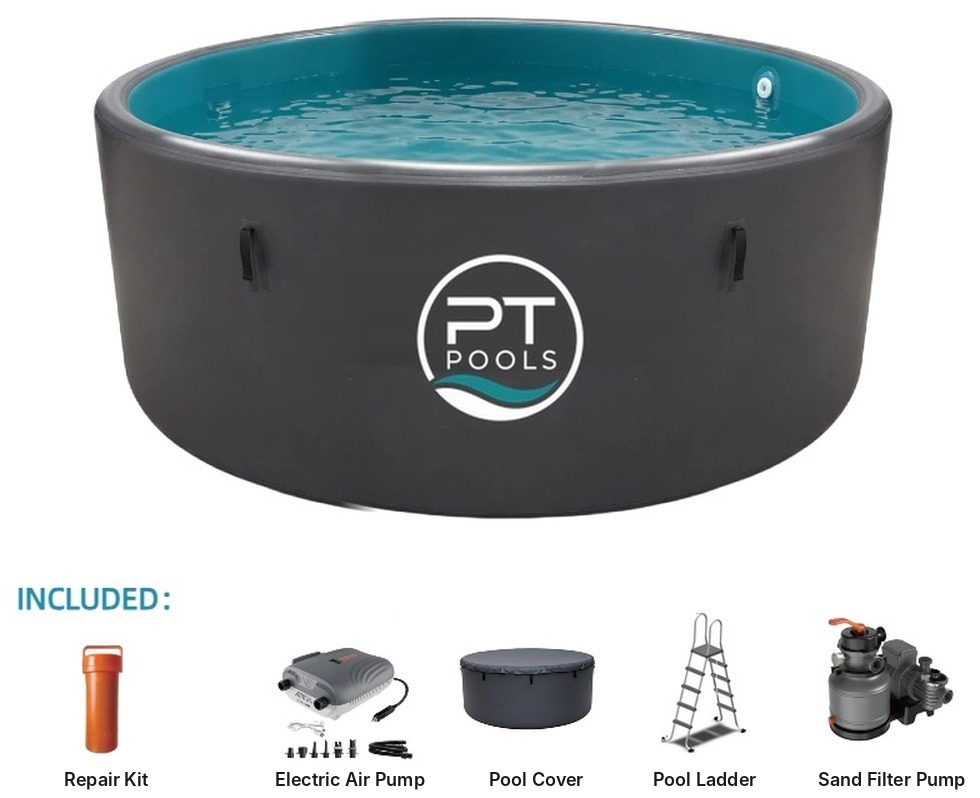
Everything You Need to Get Set Up in Under an Hour.
One box. One afternoon. Everything included to get in the water.
TheraTank Pool
Marine-grade drop-stitch PVC. 60" walls, 54" usable water depth. Rigid when inflated. 9'8" round — fits most backyards and garages.
Electric Air Pump
High-pressure electric pump does all the inflating for you. One person. No tools. No help needed.
2,300 GPH Sand Filter + Pump
With built-in skimmer. Most pool companies ship a small paper-cartridge filter that couldn’t keep a kiddie pool clean, and you’re tossing cartridges every few weeks. We refused to add to that waste, so we include a 2,300 GPH sand filter instead. No cartridge waste, no constant replacements. Sand lasts up to 5 years: fill it once, and there’s nothing else to buy for years.
Ladder + Cover
Sturdy step-over ladder with a 300 lb weight-rated top platform, plus a cover that keeps debris out and helps retain water temperature between sessions.
How It's Made
Drop Stitch Technology.
Built Tough.
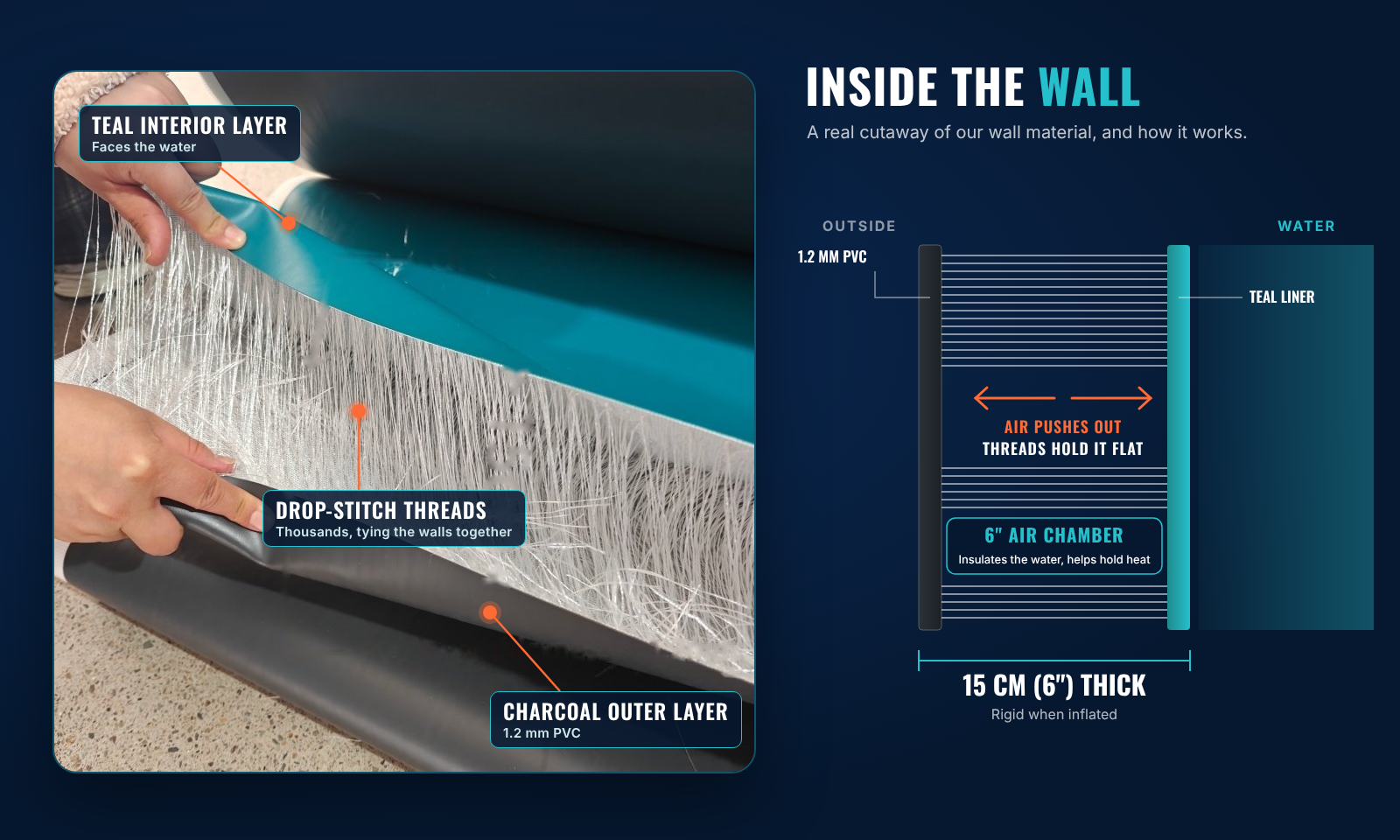
TheraTank is built with marine-grade PVC drop-stitch construction, the same material and technology used in special-ops raiding boats and whitewater gear. So you know it's built tough! Drop stitch construction creates thick, rigid walls that don't flex, bow, or give under pressure. When inflated, it feels solid. Because it is.
That air chamber inside each wall does more than add strength — it acts as insulation, helping your water hold its temperature longer than a thin steel frame ever could. Less heat loss means less heating cost, and more time in the water.
The Science
Why Water Works Differently
10 physics-based effects exclusive to water — impossible to replicate on land.
Continuous Lymphatic Pumping
Hydrostatic pressure acts like a full-body compression garment — actively squeezing interstitial fluids out of limbs to reduce swelling and inflammation. Unlike compression socks or sleeves, this effect is three-dimensional and continuous.
Gravitational Offloading (Buoyancy)
At chest depth, buoyancy counteracts approximately 75% of your body weight — removing gravitational compression from joints, spinal discs, and connective tissue during exercise. This is what makes aquatic exercise possible for people who cannot exercise on land without pain. It is physically impossible to replicate outside of water.
Enhanced Venous Return
Water pressure forces pooled blood from your lower extremities back to the heart, increasing stroke volume and cardiovascular efficiency. Your heart works smarter, not harder.
Concentric-Only Training
Fluid drag replaces gravity as resistance. This eliminates eccentric (lengthening) muscle contractions — the phase responsible for micro-tears and delayed-onset muscle soreness (DOMS). Aquatic exercise lets you work hard and wake up ready.
Balanced Agonist / Antagonist Work
Water pushes back in every direction. That means opposing muscle pairs — biceps and triceps, quads and hamstrings — are engaged simultaneously. The result is more symmetrical strength development than most land-based training allows.
Thicker Fiber Hypertrophy
Concentric-focused resistance builds muscle volume by increasing fiber thickness (myofibrillar hypertrophy) rather than fiber length. This means functional, dense strength gains with less recovery demand.
Pulmonary Conditioning
Hydrostatic pressure compresses the chest, forcing your respiratory muscles to work up to 60% harder just to expand your lungs. Regular aquatic exercise measurably improves respiratory muscle strength — a unique benefit unavailable on any treadmill.
Accelerated Heat Dissipation
Water conducts heat 25× faster than air. Your core temperature stays lower during aquatic exercise, dramatically reducing sweat-induced dehydration and heat exhaustion risk — especially valuable for older adults and those with chronic illness.
Thermodynamic Calorie Boost
When water temperature is slightly below body temperature, your metabolism works harder to maintain core heat while exercising. The result: more calories burned per session compared to the same effort performed on land.
Proprioceptive Training
Water presses on every inch of submerged skin and shifts with every move you make. That constant pressure and turbulence feeds a steady stream of sensory input to the receptors in your skin, muscles, and joints, while your stabilizing muscles make continuous micro-corrections to keep you upright. The result is sharper body awareness and coordination — the foundation of balance.